In this article and video, we investigate how well modern games run with very limited number of threads and cores available to them. In this case, dropping all the way to just a single Core Core (with 2 threads) by leveraging an AMD Ryzen 9 9950X3D and an Nvidia RTX 5090 graphics card.
AMD’s Ryzen 9 9950X3D is a 16 core/32 thread CPU, and has a very interesting design – because the first of its two CCDs is augmented with 64MB of additional L3 cache, with the second CCD missing this extra bolted-on memory. The goal here is to ensure that the CPU remains the limiting factor as much as possible, so Nvidia’s GeForce RTX 5090 remains a critical component, but even so – we need use a combination of DLSS or lower resolutions to keep GPU usage (with default thread behavior) below max, so as we try different CPU settings, the GPU still has some headroom.

I did however, wish to leave some form of ray tracing enabled – for example, Spider-Man 2 features Ray Tracing set to high, and RE9 Ray Tracing is also set to high, but not path tracing. This is to push even more workload to the CPU, and again, DLSS or resolution is instead used to help reduce the GPU overhead.
For games I wanted to test, I stuck with several newer titles including Resident Evil 9, Cyberpunk 2077, Doom the Dark Ages, Spider-Man 2, Marvel Rivals, CS2 and Warhammer Space Marines 2, and also threw in a few older titles (Batman Arkham Knight and Rise of the Tomb Raider) just to see how well older games faired.
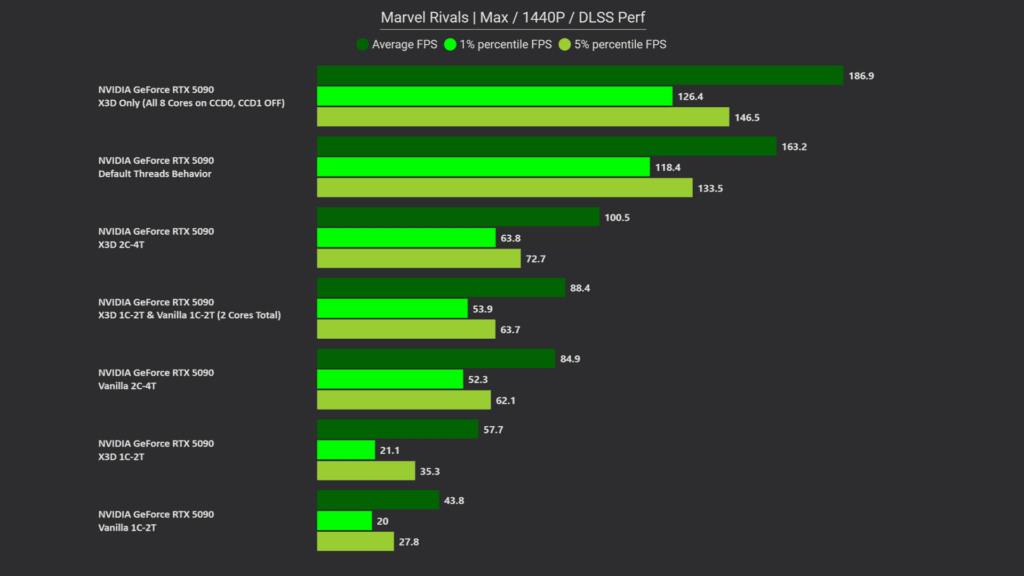
I’ll throw in the raw benchmark graphs into this article, but you can check the full video for more context on how everything was performed. In the video, I also show off some in-game footage and testing too, where as the benchmarks are performed strictly with the same sections over and over again (or in the case of Marvel Rivals for example, the internal benchmark was used).
For further explanation of the testing, I ran the games with the following different configurations on the Ryzen 9 9950X3D to see how the benchmarks scaled.
I achieved the limitation of threads by using CPU Set Setter. I opted to use this software in-place of BIOS because of a few reasons:
- BIOS options on my board when it came to reduced CPU were a bit messy, and I could use Ryzen Master to disable cores, but this brings me to point 2,
- Background tasks eat up a ton of reserves for modern Windows OS. To more accurately test the game and the engine limitations, I thought it would be fairer to restrict threads only.
There’s no ‘perfect scenario’ here, because you can make an argument that in restrictive scenarios you won’t have those cores, but it was a judgement call.
Default Thread Behavior – this is just how a game would run with AMD drivers/Windows 11 handling things as default.
X3D Only CCD (8 Cores) – Effectively limiting the game threads to just the Ryzen 9 9950X3Ds CCD0, and treating it effectively like a Ryzen 9800X3D. The only difference is that the OS can still throw stuff to the second CCD (eg background tasks)
X3D Only CCD (2 Cores) – The same as above, albeit with only 4 threads, 2 cores available to games.
Vanilla Only CCD – As you’ve probably guessed, this turns the Ryzen 9 9950X3D into effectively a Ryzen 9700X, with all 8 cores/16 threads.
Vanilla Only CCD (2 Cores) – 2 Cores / 4 Threads only like we tested on CCD0, but notably worse because of the lack of VCache.
X3D Only CCD (SINGLE CORE) – Two threads only, and this is where many games really struggled.
Vanilla Only CCD (SINGLE CORE) – The worst performing configuration, though a few games can run (just about)
X3D 1 Core / Vanilla 1 Core – 2 Cores total, 4 threads, but splitting the available cores across both CCDs. More compute than a single core, but intra-CCD latencies become a huge issue.
Benchmarks:
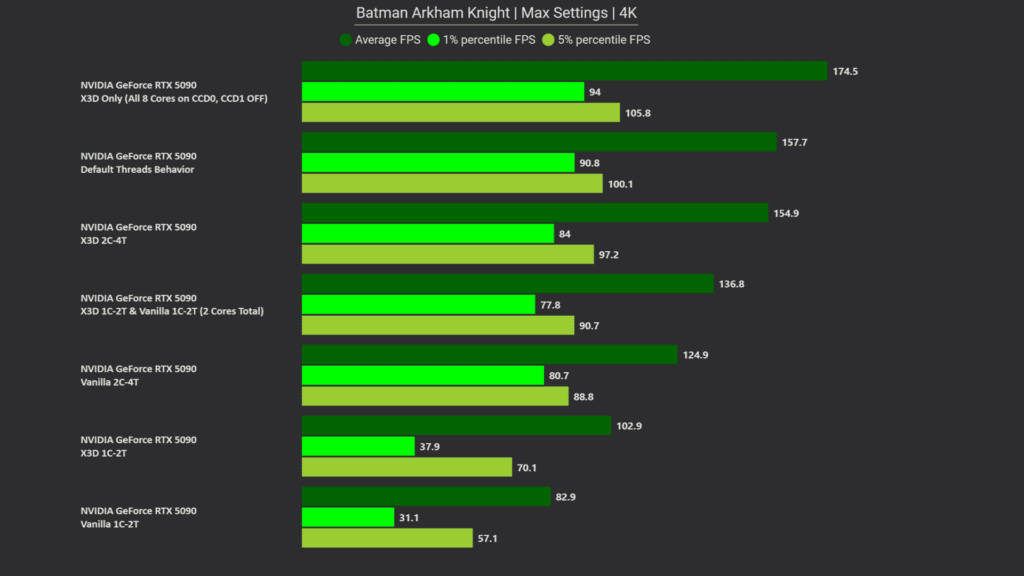
I think one thing which constantly surprised me with this setup is that so many games were ‘playable’ with just 2 cores. Would you want to play games like Spider-Man 2 like this, hell no. But technically, I think with frame rate limitations in place, and potentially tweaking settings a little and maybe even using frame generation to help smooth things out…
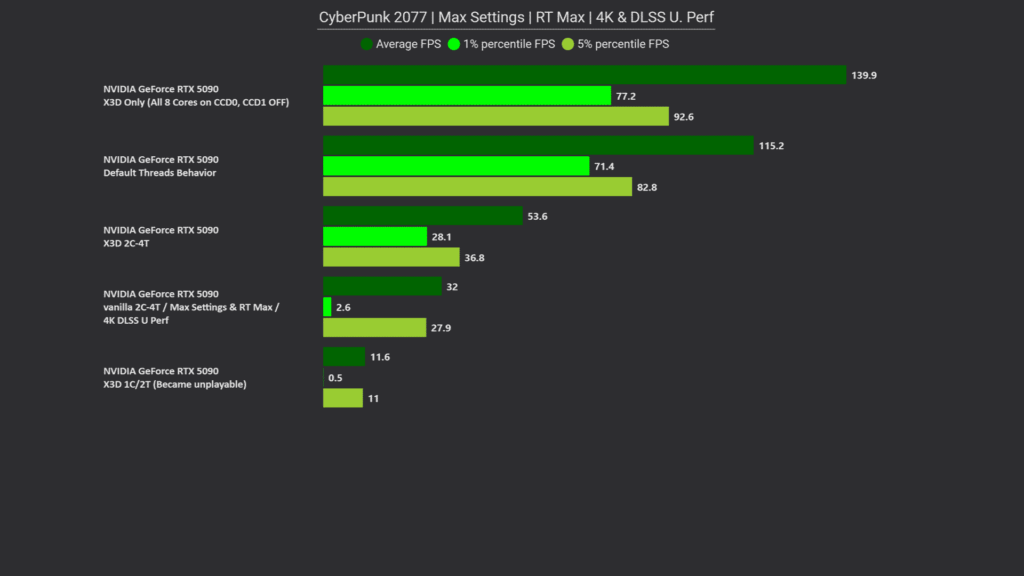
Cyberpunk 2077 on a single CPU core essentially crashed, though the moment extra threads were given to it, the game returned to normal. 1 Core on both CCDs was super interesting for Cyberpunk too, other games like Space Marines 2 was notably better with the extra thread, but Cyberpunk simply laughed. I’m guessing the engine didn’t like the latency of the two CCDs.
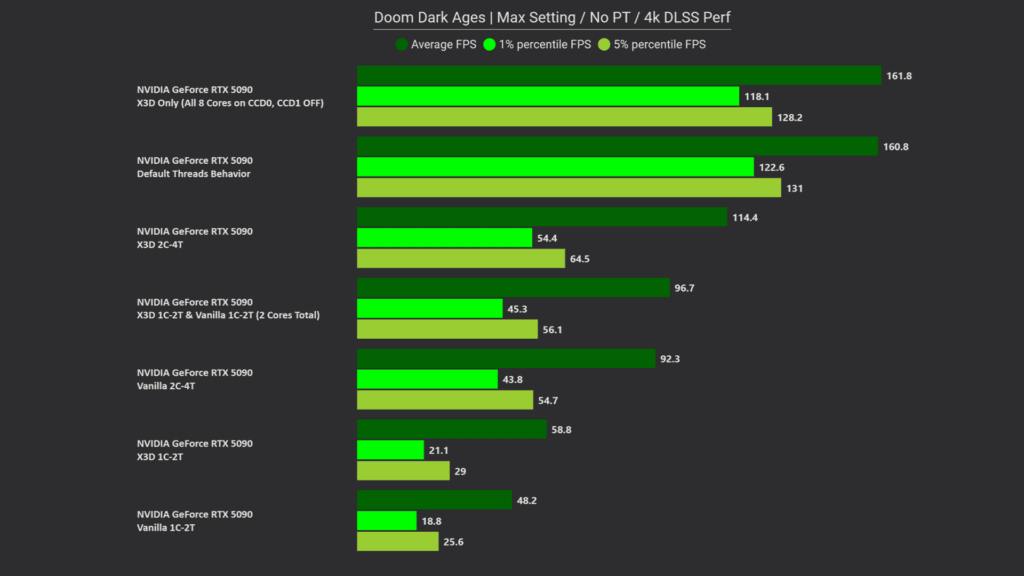
Testing out Doom the Dark Ages (with Path Tracing disabled, but otherwise, maxing out the settings) and it really makes me hope that ID Software (and Microsoft) don’t abandon the ID Tech engine. I benchmarked using the Siege 1 section of the game, with large open environments, tons of enemies and a lot of stuff happening. Despite this, with just a single CPU core, the game averaged just under 60FPS when on the X3D CCD with all settings to ultra nightmare. That’s nothing short of very impressive.
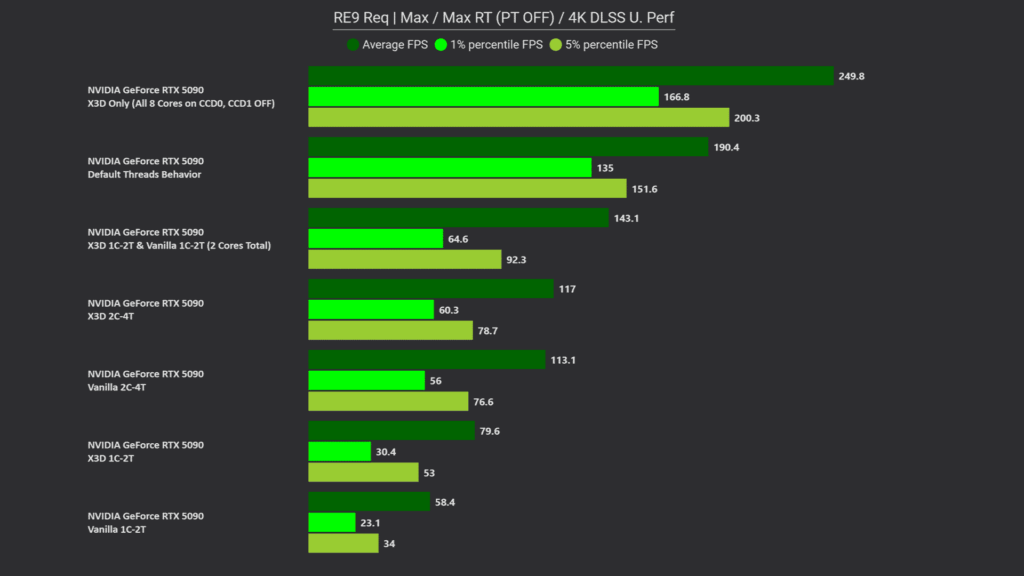
I was perhaps most surprised by Resident Evil 9 – the RE Engine scales amazingly well on different hardware configurations, and here running through an earlier section of the game with Grace is pretty darn playable with only a single core. I’d wager that if I limited frame rates (say, 30-40FPS) and tweaked the settings, you could play through the entire game with just a single core on the Ryzen 9 9950X3D. Which is pretty damn cool.
Actually, saying that – Space Marines 2 also shocked me a bit. I didn’t have benchmarks of this, it’s only in the video as it was a rather late addition to testing, but it plays very well with just a single core. Like all the other games, the Vanilla only CCD really hurts performance, but yeah, despite waves of enemies, the game just keeps on ticking.
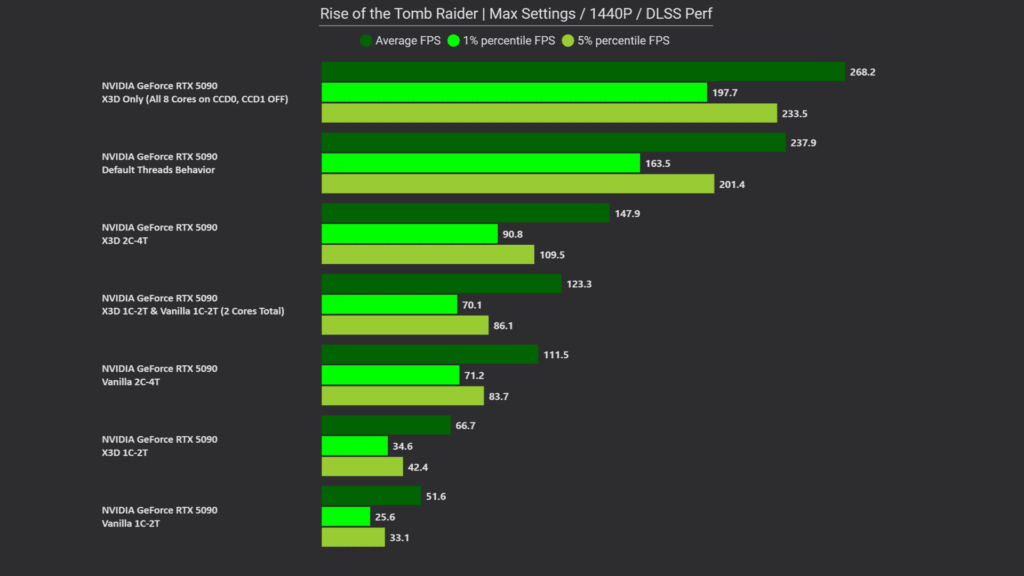
Rise of the Tomb Raider using that fancy new DirectX 12 API we’ve been hearing so much about. It’s amazing how a game that’s that released near the start of the 8th generation consoles still looks amazing.
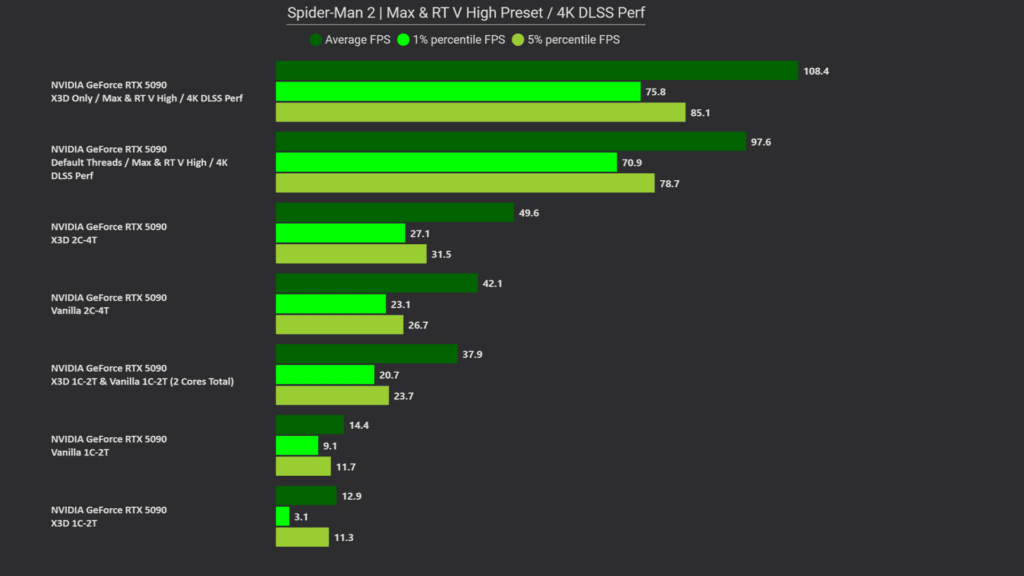
The performance of Spider-Man 2 here might make you think that the X3D CCD is bucking the trend, but believe me – that’s not the case. Performance was super unstable, and it’s very very difficult to simply not aim the camera directly at the sky or something else because of huge input latency. During gameplay, the X3D CCD wins handily (as is very readily apparent with the 2 Core results).
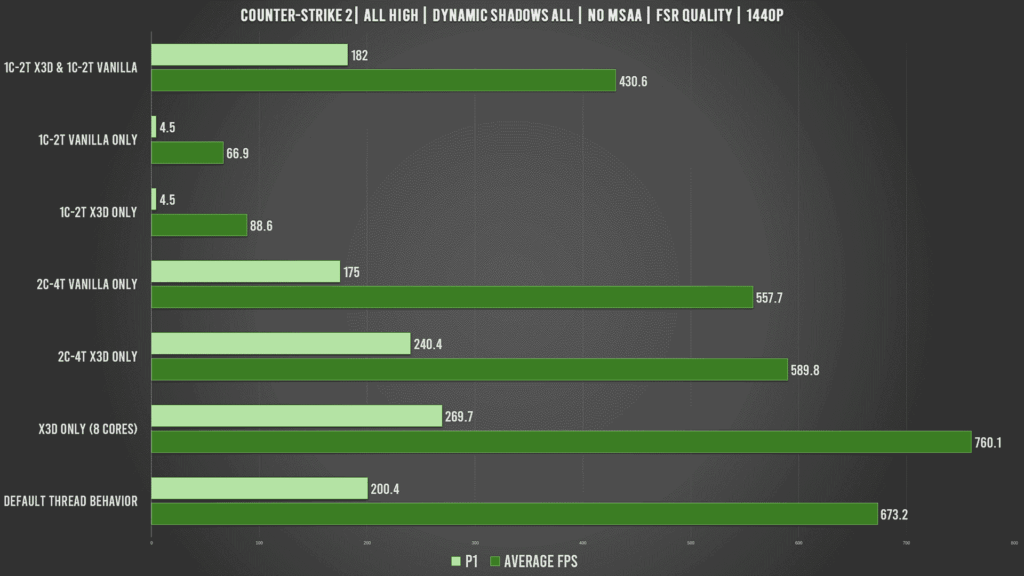
If you’re a competitive CS2 gamer, you may find that a single core affects your gaming performance a little bit. Clearly, the Source 2 engine doesn’t have the latency qualms that we see with Cyberpunk 2077. I used the a community benchmark test for repeatability here, specifically on the Ancient map.
Final thoughts:
It was a fun project, and testing how modern games scale in low core count scenarios is very interesting. It also gives me a ton of ideas for future projects, so if you’re curious about those, definitely subscribe to the channel and keep an eye on the website.