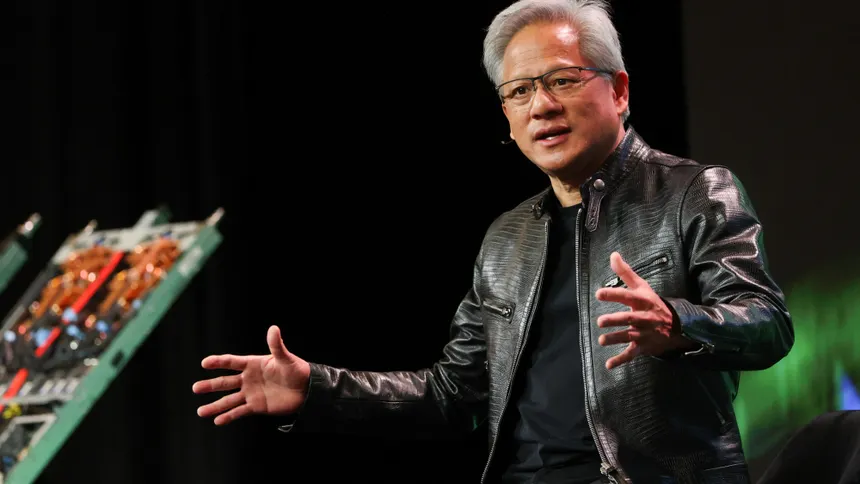
In a rare moment of saying the quiet part loud, the Nvidia CEO Jensen Huang made some very interesting comments this week where he admitted that “the fact that everything is scarce is fantastic for us”.
For some context, this comment was made during the Morgan Stanley Technology, Media and Telecom Conference this week which were then shared by VideoCardz, when the topic of discussion was the recent AI boom and the strain the demand for memory, packaging, wafers, packaging and even power said boom has caused.
He stated, “You know what? Go ahead and set up the DRAM plant because I’m gonna use it.. […] that goes a long way. You might as well take that to the bank, as many of them have. I think the fact that everything is scarce is fantastic for us.”
“I love constraints. I love constraints. The reason for that is because in a world of constraint, you have no choice but to choose the best. You can’t squander your choice. If the data centres, if the land, power, and shell is constrained, you’re not gonna randomly put something in there”
Now obviously, while Jensen was talking about the AI market during this, it’s not exactly a secret that the shortages have already caused huge issues in the gaming and hardware market – not just in availability, but in pricing as well.
You can see a full breakdown of the memory prices recently over at PC Part Picker, and of course memory is just one area where we have seen the impact of AI data centres and other infrastructure soaking up all the hardware and hoarding it like some kind of digital Smaug.
While GPU prices have risen, the real impact felt here is availability and genuine concern for the future. Just what kind of impact could this shortage have on the pricing and availability of the next gen GPUs, if prices are still in the stratosphere? (And that’s not even mentioning the potential impact on console development.) According to Nanya Technology and reported by Taipei Times, the DRAM shortage is currently predicted to last into 2028.
Obviously, production is being increased and companies are looking outside of the usual suspects for memory, so we shall and to wait, see, and let’s be real here – hope.